


Double Distillation Manufacturer in India


Water purity is non-negotiable in laboratories, pharmaceutical production, and industrial processes. Even trace contaminants — dissolved gases, organic compounds, or ionic impurities — can compromise reagent preparation, analytical accuracy, and the quality of pharmaceutical formulations. This is where the double distillation unit becomes indispensable, producing water of exceptional purity through a two-stage distillation process.
For laboratories, hospitals, and pharmaceutical units across the country, sourcing from a reputable double distillation manufacturer in India ensures consistent water quality, long-term equipment reliability, and compliance with pharmacopeial standards. This guide covers everything you need to know — how double distillation units work, their applications, the types available, and what to look for in a manufacturer.
What Is a Double Distillation Unit?
A double distillation unit purifies water through two successive distillation cycles. In the first stage, tap or feed water is boiled and converted to steam, leaving behind dissolved solids, minerals, and many impurities. This single-distilled (SD) water is then fed into a second distillation chamber, where the process is repeated — removing residual volatile impurities, pyrogens, and traces of dissolved gases.
The result is double-distilled (DD) water — water of significantly higher purity than single-distilled water, with conductivity values typically below 2 µS/cm, making it suitable for the most demanding laboratory and pharmaceutical applications.
How Double Distillation Units Work
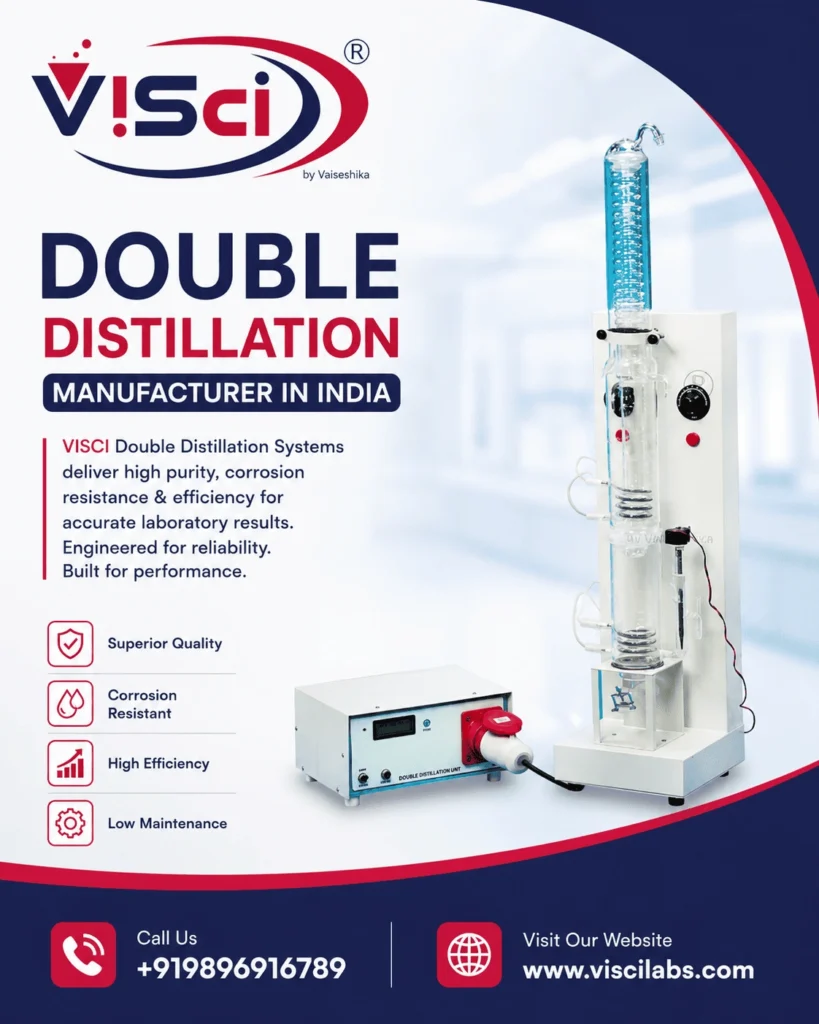
A typical double distillation unit consists of:
Feed Water Inlet and Storage: Raw water (often pre-treated through softening or reverse osmosis) enters the system and is stored before the distillation process begins.
First-Stage Boiling Chamber (Evaporator 1): Water is heated to its boiling point using electric heating elements, generating steam while leaving behind dissolved minerals, salts, and non-volatile contaminants.
First Condenser: Steam from the first chamber is condensed back into liquid form, producing single-distilled water.
Second-Stage Boiling Chamber (Evaporator 2): The single-distilled water is fed into the second chamber and boiled again, vaporising it a second time and leaving behind any remaining trace impurities that survived the first cycle.
Second Condenser: Steam from the second chamber is condensed into the final double-distilled water output, which is collected in a storage vessel or directly fed to point-of-use applications.
Borosilicate Glass or Stainless Steel Construction: Most components in contact with water — boiling chambers, condensers, and connecting tubes — are made from borosilicate glass (for chemical purity) or high-grade stainless steel (304 or 316 grade, for durability and pharmaceutical compliance).
Auto Cut-Off and Safety Controls: Modern units include low-water-level cut-offs, overheating protection, and automatic shut-down features to ensure safe, unattended operation.
Types of Double Distillation Units Available in India
Indian manufacturers produce double distillation units in various configurations to suit different scales and budgets:
All-Glass Double Distillation Units
Constructed entirely from borosilicate glass, these units are favoured in analytical and pharmaceutical laboratories where water purity must be free from any metallic contamination. They are commonly used for producing water for injection (WFI) testing, reagent preparation, and analytical chemistry.
Stainless Steel Double Distillation Units
Built using SS304 or SS316L grade stainless steel, these units are robust, long-lasting, and well-suited to industrial and high-volume pharmaceutical applications. Stainless steel construction also simplifies cleaning and sterilisation, supporting GMP compliance.
Combination (Glass-Steel Hybrid) Units
Some manufacturers offer hybrid designs — stainless steel heating chambers paired with glass condensers — balancing durability with the purity benefits of glass-contact surfaces.
Capacity Variants
Double distillation units in India are typically available in capacities ranging from 2 litres/hour for small laboratories to 50+ litres/hour for industrial-scale operations, allowing buyers to select based on their daily water demand.
Automatic vs. Semi-Automatic Models
Automatic units feature continuous operation with auto fill, auto cut-off, and digital monitoring, while semi-automatic units require more manual oversight — typically a more economical choice for smaller labs with lower water demands.
Applications of Double Distilled Water
Double distilled water produced by these units serves a wide range of critical applications:
Pharmaceutical Manufacturing: Used in the preparation of injectable formulations, reagent solutions, and as a key input for water for injection (WFI) systems, governed by strict pharmacopoeial standards (IP, BP, USP).
Analytical and Research Laboratories: Essential for preparing reagents, standard solutions, buffers, and mobile phases for HPLC and other analytical techniques where trace contamination can affect results.
Hospital and Clinical Laboratories: Used in autoclaves, diagnostic reagent preparation, and equipment cleaning where mineral-free water prevents scaling and contamination.
Battery Manufacturing: Lead-acid battery production requires high-purity water free from mineral content that could affect battery performance and lifespan.
Cosmetics and Personal Care Manufacturing: Formulations requiring purified water as a base ingredient rely on double-distilled water to maintain product stability and purity.
Educational and Research Institutions: Chemistry, biology, and biotechnology departments use double-distilled water extensively for experiments, microbiological media preparation, and equipment rinsing.
Key Features to Look for in a Double Distillation Unit
When evaluating products from a double distillation manufacturer in India, consider the following technical features:
Output Purity and Conductivity
The unit should consistently produce water with conductivity below 2 µS/cm, indicating the removal of nearly all dissolved ionic impurities.
Build Material
Borosilicate glass offers the highest chemical inertness, while SS316L stainless steel offers durability and ease of cleaning for industrial settings. The choice depends on your application’s purity requirements and operational environment.
Heating Element Quality
Heating elements should be corrosion-resistant (typically made from Incoloy or high-grade stainless steel) and rated for continuous operation without scaling-related failures.
Energy Efficiency
Look for units with heat recovery systems that use the heat from the first distillation stage to pre-warm feed water for the second stage, reducing overall energy consumption.
Safety Features
Automatic low-water cut-off, thermal overload protection, and pressure relief mechanisms are essential for safe, unattended operation — particularly important in continuous-use pharmaceutical settings.
Ease of Maintenance
Units with accessible heating elements, removable condensers, and straightforward descaling procedures reduce downtime and extend operational life — particularly relevant in hard-water regions.
Compliance Documentation
For pharmaceutical buyers, manufacturers should provide validation documentation, material certificates, and compliance with relevant pharmacopoeial water quality standards.
Why Choose a Double Distillation Manufacturer in India
Sourcing double distillation units domestically offers several practical advantages:
Cost-Effectiveness: Indian-manufactured units are significantly more affordable than imported alternatives, without compromising on core performance — particularly important for institutions purchasing multiple units or planning facility-wide rollouts.
Faster Delivery and Installation Support: Domestic manufacturers can typically deliver, install, and commission units far faster than international suppliers, minimising downtime during facility setup or equipment replacement.
Spare Parts Availability: Heating elements, glass components, and gaskets are consumable parts that require periodic replacement. Domestic manufacturers ensure these are readily available, avoiding long waits for imported spares.
After-Sales Service: On-site servicing, calibration support, and troubleshooting assistance are far more accessible when working with an Indian manufacturer, reducing equipment downtime.
Customisation for Local Conditions: Indian manufacturers understand local water quality variations (hardness, TDS levels) and can recommend appropriate pre-treatment systems and unit configurations suited to regional feed water conditions.
Common Industries and Buyers of Double Distillation Units in India
- Pharmaceutical Manufacturing Units – for WFI systems and reagent preparation
- Hospitals and Diagnostic Laboratories – for autoclave feed water and reagent preparation
- Research Institutions and Universities – for chemistry, biology, and biotechnology laboratories
- Cosmetic and Personal Care Manufacturers – for formulation water
- Battery Manufacturing Plants – for electrolyte solution preparation
- Food and Beverage Quality Control Labs – for reagent and standard solution preparation
- Government Testing Laboratories – for water and environmental testing applications
Frequently Asked Questions
Q.1 What is the difference between single distilled and double distilled water?
Single distilled water passes through one distillation cycle, removing most dissolved minerals and salts. Double distilled water undergoes a second distillation cycle, removing residual volatile impurities, pyrogens, and trace contaminants left behind after the first pass — resulting in significantly higher purity, typically with conductivity below 2 µS/cm.
Q.2 Which is better for a lab — a glass or stainless steel double distillation unit?
All-glass units offer the highest level of chemical inertness and are preferred for analytical work, reagent preparation, and applications requiring water free from metallic contamination. Stainless steel units (SS304 or SS316L) are more durable, easier to clean and sterilise, and better suited to high-volume, industrial, or pharmaceutical environments. The right choice depends on your purity requirements and daily water demand.
Q.3 How much water output capacity do I need for my laboratory?
Capacity requirements depend on daily consumption. Small laboratories with occasional reagent preparation needs typically require units producing 2–5 litres/hour, while pharmaceutical or industrial facilities with continuous demand may need 20–50+ litres/hour. Visci Labs can help assess your daily water usage and recommend an appropriately sized unit.
Q.4 Is double distilled water suitable for Water for Injection (WFI) applications?
Double distilled water meets the basic purity criteria required for many pharmacopoeial applications, but WFI production often involves additional validation, storage, and distribution requirements as per IP, BP, or USP standards. Manufacturers should be consulted to ensure the specific unit and accompanying documentation align with your regulatory needs.
Q.5 How often does a double distillation unit require maintenance?
Maintenance frequency depends on feed water quality, particularly hardness and TDS levels. In hard-water regions, heating elements and boiling chambers may require descaling every few weeks to a few months to maintain efficiency and prevent scale buildup. Units with accessible components and proper pre-treatment (such as softened or RO-treated feed water) require less frequent maintenance.
Visci Labs: Your Trusted Double Distillation Manufacturer in India
When you need a reliable double distillation manufacturer in India, Visci Labs delivers precision-engineered units designed to consistently produce high-purity double-distilled water for laboratory, pharmaceutical, and industrial use. With a focus on robust construction, energy-efficient operation, and dependable after-sales support, Visci Labs equips laboratories and manufacturing facilities with the water purification systems they can rely on day after day. Whether you need an all-glass unit for analytical purity or a stainless steel system for industrial-scale output, Visci Labs has a solution built for your requirements. Visit viscilabs.com to explore the range and get in touch with our team today.
Most Searched Keywords
- Double Distillation Unit Manufacturer in India
- Top Double Distillation Unit Manufacturer in India
- Best Double Distillation Unit Manufacturer in India
- Double Distillation Unit Manufacturers
- Double Distillation Unit Manufacturers India
- Double Distillation Manufacturer in India
- Top Double Distillation Manufacturer in India
- Best Double Distillation Manufacturer in India