

Lab Equipment Exporters in Uganda
Ask ten procurement managers where they source laboratory instruments, and most will name the usual suspects: Europe, China, or the United States. Few will mention East Africa. Yet the market for lab equipment exporters in Uganda is quietly growing, and Indian businesses, distributors, and research institutions are starting to notice.
Whether you run a diagnostic chain, supply schools, or manage a university lab, understanding how this market works can save you money and time. This guide explains what Ugandan exporters offer, how to vet them, and where Indian buyers fit in.
Why Uganda Is Becoming a Notable Name in Laboratory Supply
Uganda has one of East Africa’s fastest-growing healthcare and education sectors. Universities, public hospitals, agricultural research centres, and private diagnostic labs are all expanding. That growth has created a steady demand for scientific instruments, and a small but capable network of suppliers has grown around it.
Several factors make the country interesting for trade:
- Strategic location: Uganda sits at the heart of East Africa, with road and air links to Kenya, Tanzania, Rwanda, and the Democratic Republic of Congo.
- Regional trade access: Membership in the East African Community (EAC) eases the movement of goods across member states.
- Growing research base: Institutions like Makerere University drive consistent demand for lab consumables and analytical equipment.
- Rising private healthcare: More diagnostic centres mean more need for reliable testing and analysis tools.
For Indian buyers, this means a market that is both a potential source and a gateway to wider African trade.
What Do Lab Equipment Exporters in Uganda Typically Offer?
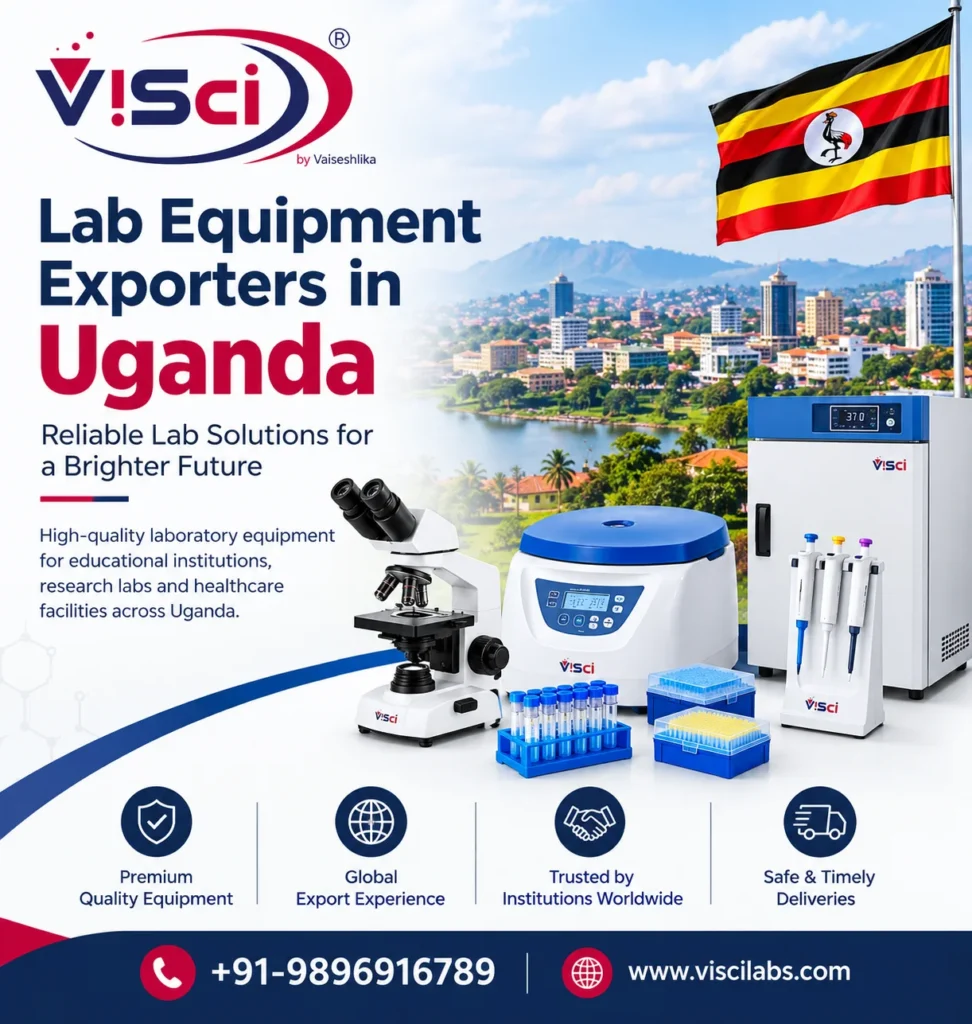
Most lab equipment exporters in Uganda work as suppliers, re-exporters, or regional distributors rather than large-scale manufacturers. Many bring in products from global brands and handle onward supply across the region. A typical catalogue includes:
- Microscopes (compound, stereo, and digital)
- Centrifuges and incubators
- Autoclaves and sterilisers
- Analytical balances and weighing scales
- Spectrophotometers and pH meters
- Glassware, plasticware, and consumables
- Water baths, hot plates, and heating mantles
- Personal protective equipment (PPE) and safety gear
- Reagents and diagnostic kits
It helps to know that Uganda’s strength lies more in distribution and regional logistics than in heavy manufacturing. Keep this in mind when comparing prices and sourcing options.
Key Types of Laboratory Equipment in Demand
Clinical and Diagnostic Instruments
Hospitals and diagnostic labs need haematology analysers, biochemistry analysers, and blood-bank refrigerators. Demand here is steady, which makes it a reliable category for exporters.
Educational and Research Equipment
Schools and universities buy basic but essential items such as microscopes, dissection kits, and glassware. Research bodies add more advanced instruments, including PCR machines and spectrophotometers.
Agricultural and Food Testing Tools
Because agriculture drives much of Uganda’s economy, soil testing kits, moisture analysers, and food-safety instruments are widely used.
How Indian Buyers Can Benefit
India is already a major producer of scientific instruments, so why look at Uganda at all? There are a few practical reasons.
- Market entry into East Africa. Indian manufacturers and traders can partner with Ugandan exporters to reach customers across the region without setting up their own offices.
- Local knowledge. A good partner understands customs processes, tender requirements, and buyer preferences that are hard to learn from a distance.
- Diversified sourcing. Businesses that sell in Africa sometimes need regional stock to shorten delivery times. Working with local exporters can fill that gap.
- Long-term trade relationships. India and Uganda share historic commercial ties, which makes introductions and trust-building easier than in many other markets.
If you want a reliable starting point for scientific equipment sourcing, platforms like Visci Labs are worth exploring to compare product ranges and understand what suppliers in this space offer.
How to Choose a Reliable Lab Equipment Exporter
Not every supplier deserves your trust. Before placing an order, run through this checklist:
Verify Registration and Credentials
Ask for business registration documents, tax details, and export licences. A genuine exporter will share these without hesitation.
Check Product Quality and Certifications
Look for ISO, CE, or equivalent certifications on instruments. For clinical devices, confirm the relevant regulatory approvals.
Request Samples or References
Past customer references say more than any brochure. If possible, ask for a sample or a small trial order.
Compare After-Sales Support
Calibration, installation, spare parts, and warranty matter as much as the purchase price. An instrument that cannot be serviced quickly becomes expensive downtime.
Understand Payment and Shipping Terms
Clarify Incoterms (such as FOB or CIF), payment methods, and delivery timelines in writing before you commit.
Common Challenges and How to Handle Them
Every cross-border deal carries some risk. These are the issues buyers meet most often:
- Shipping delays: Plan for buffer time, especially for sensitive instruments.
- Customs and documentation: Missing paperwork can hold up consignments. Keep invoices, packing lists, and certificates ready.
- Currency fluctuation: Agree on a payment currency and consider hedging for larger orders.
- Quality inconsistency: Insist on inspection reports or third-party checks before dispatch.
- Communication gaps: Confirm specifications in writing, including model numbers and voltage requirements.
Voltage and plug standards deserve a special mention. An instrument built for one electrical system can fail quickly on another, so always confirm compatibility.
Tips for Building a Smooth Export Partnership
Good trade relationships rarely happen by accident. A few habits make a real difference:
- Start with a small order to test reliability.
- Keep a clear written record of all agreements.
- Visit trade fairs or arrange video demonstrations where possible.
- Ask about warranty terms and who handles repairs locally.
- Build relationships with more than one supplier to reduce dependency.
Future Outlook
Demand for laboratory equipment in East Africa is expected to keep rising as governments invest in healthcare, education, and research. Digital trade platforms are also making it easier to discover and compare suppliers. For Indian businesses, now is a sensible time to learn the market and build contacts before competition increases.
Frequently Asked Questions
1. Who are the main lab equipment exporters in Uganda?
The market includes scientific suppliers, medical equipment distributors, and regional trading companies based mainly in Kampala. Because the sector is mostly distribution-led, always verify each company’s credentials before ordering.
2. Is it safe for Indian buyers to import lab equipment from Uganda?
Yes, provided you do proper due diligence. Check registrations, request references, use secure payment methods, and agree on clear contract terms.
3. What types of lab equipment are commonly exported from Uganda?
Common items include microscopes, centrifuges, glassware, diagnostic kits, PPE, and general-purpose laboratory instruments, many of them supplied through regional distribution.
4. What documents are needed to import lab equipment into India?
Typically you need a commercial invoice, packing list, bill of lading or airway bill, and an Importer Exporter Code (IEC). Some devices also need regulatory approvals, so check current rules with a customs professional.
5. How can I find trusted lab equipment suppliers online?
Use verified B2B directories, trade association listings, and established scientific supply platforms such as Visci Labs. Always confirm details independently before paying.
Conclusion
The market for lab equipment exporters in Uganda may not be as famous as others, but it offers real opportunities for Indian buyers who do their homework. Understand what suppliers offer, verify credentials, plan around logistics, and build relationships slowly.
Whether you want to source instruments, enter the East African market, or simply compare options, careful research is your best tool. Start small, ask questions, and let each successful order build the next one.
Most Searched Keywords
- Lab Equipment Exporters in Uganda
- Top Lab Equipment Exporters in Uganda
- Best Lab Equipment Exporters in Uganda
- Lab Equipment Exporters
- Lab Equipment Exporters Uganda