


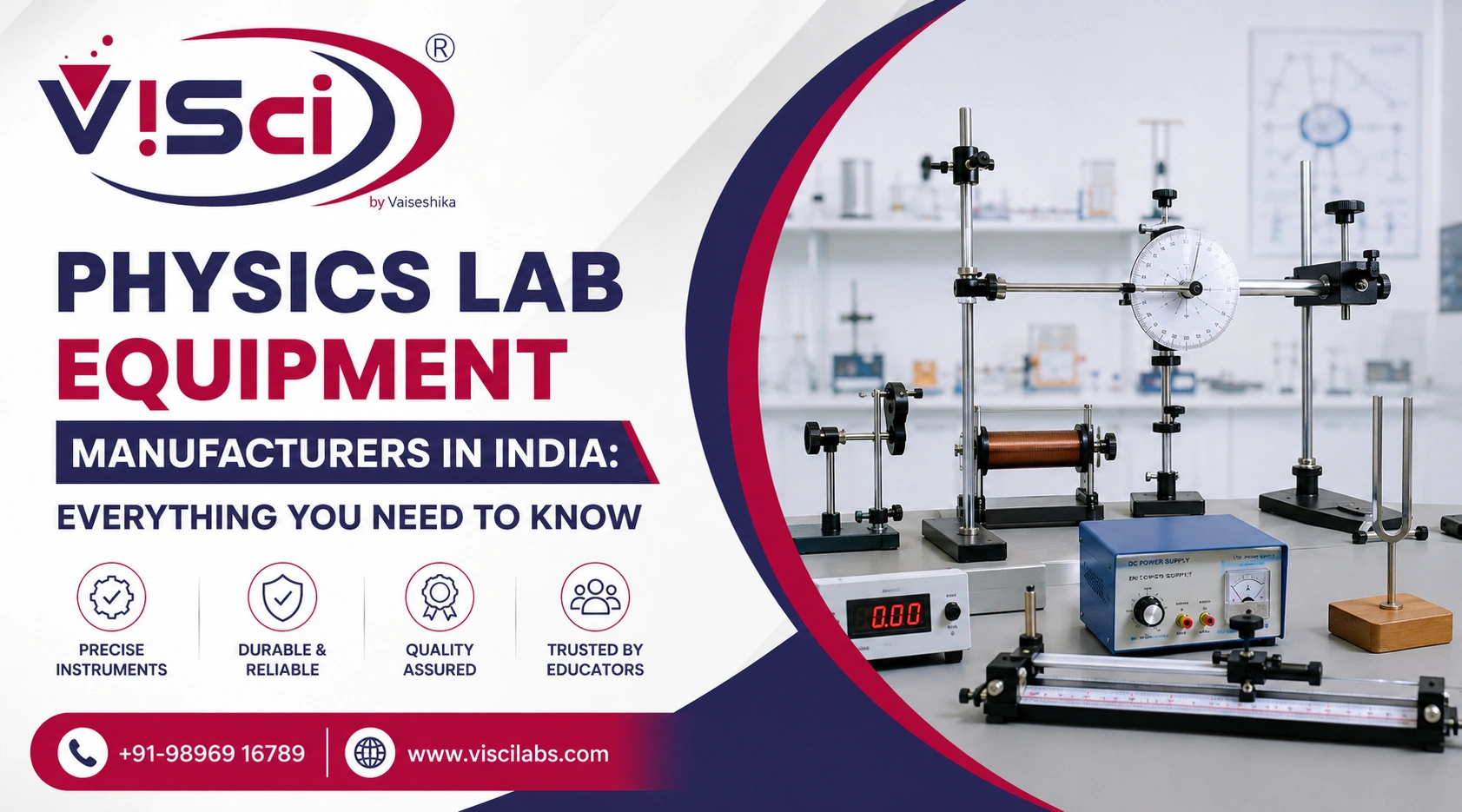
Physics is one of the most equipment-intensive subjects taught at the school and college level. From basic optics experiments to electricity and magnetism demonstrations, a physics lab depends on a wide range of specialized apparatus to bring theoretical concepts to life. As India’s education sector continues to expand — with new schools, colleges, and technical institutes being set up every year — the demand for reliable physics lab equipment manufacturers in India has grown right along with it. If you’re a school administrator, lab in-charge, or procurement officer trying to source physics equipment, understanding how India’s manufacturing landscape works can help you make a smarter purchasing decision.
Why Physics Lab Equipment Requires Specialized Manufacturing
Unlike general labware, physics equipment often involves a mix of mechanical precision, electrical components, and optical accuracy — all of which need to work reliably and consistently for classroom demonstrations and practical experiments to produce meaningful, repeatable results. A resistance box with inaccurate resistance values, or an optical bench with poorly aligned components, doesn’t just produce wrong results — it actively confuses students trying to learn foundational concepts.
This means physics lab equipment manufacturing typically requires:
- Mechanical precision for instruments like optical benches, spectrometers, and vernier calipers
- Electrical accuracy and safety for equipment such as resistance boxes, galvanometers, ammeters, voltmeters, and potentiometers
- Consistent calibration so that measurement-based experiments produce reliable, repeatable results across multiple units of the same instrument
- Durability for repeated classroom use, since school and college lab equipment is often handled by students with varying levels of experience
Common Categories of Physics Lab Equipment
Indian manufacturers typically produce physics lab equipment across the following broad categories:
- Mechanics equipment — spring balances, pendulums, inclined planes, and friction apparatus
- Heat and thermodynamics apparatus — calorimeters, thermometers, and specific heat capacity setups
- Electricity and magnetism instruments — resistance boxes, galvanometers, ammeters, voltmeters, potentiometers, and electromagnetic induction kits
- Optics equipment — optical benches, prisms, lenses, spectrometers, and ray optics kits
- Modern physics apparatus — photoelectric effect setups, radioactivity demonstration kits, and semiconductor experiment kits
- Measurement instruments — vernier calipers, screw gauges, and travelling microscopes
- Demonstration models — apparatus used for classroom demonstrations of physical principles rather than hands-on student experiments
A well-rounded manufacturer typically offers equipment across most or all of these categories, allowing schools and colleges to source their entire physics lab requirement from a single supplier rather than piecing it together from multiple vendors.
Why India Has Become a Strong Base for Physics Lab Equipment Manufacturing
1. A long-established scientific instrument manufacturing tradition. Certain regions in India — Ambala in Haryana being one of the most prominent — have been manufacturing scientific and educational lab equipment for decades, building up deep technical expertise specifically around instruments used in schools and colleges.
2. Cost-effective production without compromising accuracy. Indian manufacturers are able to produce calibrated, classroom-ready physics equipment at price points that make large-scale institutional procurement financially feasible, which matters enormously given the scale of India’s (and the world’s) school systems.
3. Standards-aligned manufacturing. Reputable manufacturers build their measurement instruments to recognized standards, ensuring that resistance boxes, ammeters, and similar equipment provide accurate, trustworthy readings for experimental work.
4. Export capability. Many Indian physics lab equipment manufacturers have expanded beyond domestic supply to export their products internationally, particularly to regions in the Middle East, Africa, and Southeast Asia where schools and colleges also rely on cost-effective, quality lab equipment sourced from India.
5. Ability to serve both education and research needs. While a large share of demand comes from school and college teaching labs, some manufacturers also produce more advanced physics instruments suited to research and higher-education laboratory settings, giving buyers flexibility as their requirements evolve.
What to Look for When Choosing a Physics Lab Equipment Manufacturers
Not all manufacturers are equal, and a few evaluation points can help you avoid ending up with unreliable or poorly finished equipment:
- Check calibration accuracy — for measurement instruments like resistance boxes or ammeters, ask whether the manufacturer calibrates each unit and can provide supporting documentation.
- Assess build quality and finishing — look at how well components like optical benches, stands, and electrical apparatus are finished, since poor build quality leads to faster wear and tear under regular classroom use.
- Review product range breadth — a manufacturer offering equipment across mechanics, optics, electricity, and modern physics saves you from having to coordinate with multiple vendors.
- Ask about after-sales support — replacement parts, repairs, and recalibration support matter over the equipment’s working life, especially for schools operating on tight maintenance budgets.
- Look for curriculum alignment — for school and college procurement specifically, it helps if the manufacturer’s product range is aligned with common curriculum requirements (CBSE, ICSE, state boards, or university syllabi).
- Confirm bulk order capability — institutions often need multiple units of the same instrument for practical batches, so consistent quality across large quantities matters more than it might for a single research-grade purchase.
Manufacturer vs. Supplier: Why It Matters for Physics Equipment
As with other lab equipment categories, buyers should understand the difference between a manufacturer and a supplier or trader. A manufacturer produces the equipment directly, which typically means better pricing for bulk orders, more consistency across units, and direct accountability if something needs to be repaired, recalibrated, or replaced. A supplier or trader, on the other hand, may source from multiple manufacturers, offering broader variety but less consistency and a less direct line of accountability when issues arise.
For physics lab equipment specifically — where measurement accuracy directly affects the quality of student experiments — sourcing from a manufacturer rather than a multi-brand trader is generally the safer long-term choice.
Final Thoughts
Physics lab equipment sits at an interesting intersection of mechanical craftsmanship, electrical engineering, and optical precision, which makes manufacturing quality especially important compared to more generic laboratory supplies. India’s established manufacturing hubs, decades of accumulated expertise, and cost-effective production have made the country a reliable source for schools, colleges, and institutions both domestically and internationally. Whether you’re setting up a new physics lab, replacing aging equipment, or sourcing for an export order, working with an experienced, quality-focused physics lab equipment manufacturers in India is one of the most practical ways to ensure your lab stays accurate, durable, and classroom-ready for years to come.
Frequently Asked Questions
Q.1 What is physics lab equipment used for?
Physics lab equipment is used to demonstrate and verify physical principles through hands-on experiments and classroom demonstrations, covering areas like mechanics, heat, electricity and magnetism, optics, and modern physics.
Q.2 Why is India a strong hub for physics lab equipment manufacturing?
India has decades of manufacturing expertise in scientific instruments, particularly in hubs like Ambala, along with cost-effective production, standards-aligned calibration, and growing export capability to international markets.
Q.3 What should I check before buying physics lab equipment in bulk?
Check calibration accuracy, build quality, product range breadth, after-sales support, curriculum alignment, and the manufacturer’s ability to maintain consistent quality across bulk orders.
Q.4 What’s the difference between a physics lab equipment manufacturer and a supplier?
A manufacturer produces the equipment directly, offering better pricing, consistency, and accountability, while a supplier or trader typically sources from multiple manufacturers, offering variety but less direct quality control.
Q.5 Can Indian manufacturers supply physics lab equipment for both schools and colleges?
Yes, most established manufacturers offer equipment suited to both school-level teaching labs and college or university-level practical and research work.
Q.6 Do Indian physics lab equipment manufacturers export internationally?
Yes, many manufacturers export physics lab equipment to schools, colleges, and institutions across the Middle East, Africa, Southeast Asia, and other regions.
Q.7 How important is calibration for physics lab equipment like resistance boxes and ammeters?
Very important — inaccurate calibration directly affects experimental results, so buyers should confirm that measurement instruments are properly calibrated and, where possible, request supporting documentation.