


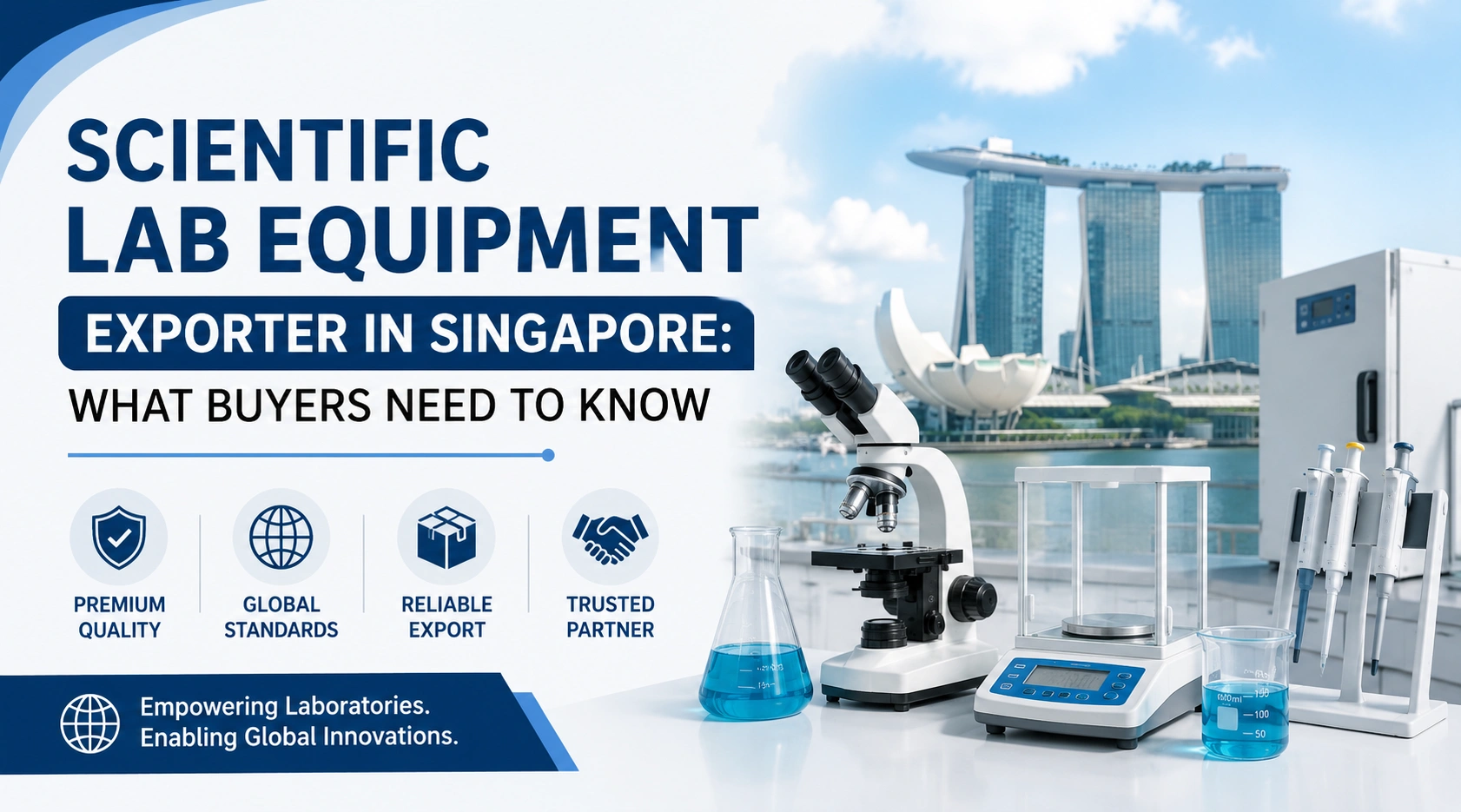
Singapore has positioned itself as one of Asia’s leading hubs for biomedical research, pharmaceutical manufacturing, and higher education — home to institutions like NUS, NTU, A*STAR research centers, and a fast-growing biotech and pharma manufacturing base in Tuas Biomedical Park. All of this demands a steady, reliable supply of scientific lab equipment, from basic glassware to precision analytical instruments. Since Singapore has limited domestic manufacturing for laboratory instruments, most institutions and companies there depend on Scientific Lab Equipment Exporter in Singapore has become one of the most trusted sourcing destinations for this demand.
Why Singapore Imports Most of Its Lab Equipment
Singapore’s economy is built around high-value services, finance, biomedical R&D, and advanced manufacturing rather than bulk industrial production of laboratory instruments. While the country has world-class labs and research facilities, very little of the actual glassware, benchtop equipment, and teaching lab apparatus used in these facilities is manufactured locally. Instead, universities, hospitals, testing laboratories, polytechnics, and pharmaceutical companies in Singapore source their equipment from established exporters in countries with strong scientific manufacturing bases — India being one of the most prominent, alongside Germany, the US, and China.
This creates consistent demand across several segments:
- Higher education and polytechnics needing physics, chemistry, and biology lab equipment for teaching labs
- Pharmaceutical and biotech companies needing QC and R&D instruments such as dissolution testers, stability chambers, and analytical balances
- Hospitals and diagnostic labs needing glassware, microscopes, and general labware
- Government research institutions needing calibrated, standards-compliant instruments for testing and certification work
Why India Is a Preferred Source for Singapore’s Lab Equipment Imports
1. Manufacturing depth and cost efficiency. India has decades of accumulated expertise in scientific instrument manufacturing, particularly in established clusters like Ambala, Haryana — often called India’s “science city” for its concentration of laboratory equipment manufacturers. This lets Indian exporters offer competitive pricing without compromising on build quality.
2. Standards compliance built for export markets. Reputable Indian manufacturers build their glassware and instruments to international standards — ASTM, DIN, ISO, and NABL calibration — which are widely recognized and accepted by Singaporean institutions, universities, and regulatory bodies.
3. Established trade relationships. India and Singapore share strong trade ties through ASEAN-India trade agreements, and Singapore’s port infrastructure makes it one of the easiest Asian markets to ship to from Indian ports, keeping freight costs and transit times competitive.
4. Wide product range from a single source. Rather than sourcing chemistry glassware from one supplier, physics equipment from another, and pharma QC instruments from a third, Singaporean buyers increasingly prefer exporters who can supply across categories — glassware, metalware, optical instruments, physics and chemistry lab equipment, and pharma-grade instruments — under one purchase order and one shipment.
Common Categories of Lab Equipment Exported to Singapore
Exporters supplying Singapore typically cover a broad catalog, including:
- Laboratory glassware — beakers, flasks, burettes, pipettes, and volumetric glassware calibrated to Class A / ASTM / DIN standards
- General labware and plasticware for routine lab use
- Educational and school laboratory equipment for polytechnics and secondary/tertiary institutions
- Physics lab equipment including resistance boxes, optical benches, and measurement instruments
- Chemistry lab equipment for titration, distillation, and general analytical work
- Biology lab equipment, including dissection kits and models
- Optical instruments and microscopes, from student-grade to research-grade
- Pharma and QC lab equipment, such as dissolution testers, stability chambers, and analytical balances
- Laboratory metalware including stands, clamps, and tripods
What to Look for in a Scientific Lab Equipment Exporter
If you’re sourcing lab equipment from India for use in Singapore, a few due-diligence points will help you avoid costly delays or quality issues:
- Export documentation experience — the exporter should be able to handle commercial invoices, packing lists, certificates of origin, and any product-specific certifications Singaporean customs or institutions require.
- Calibration and traceability certificates — especially important for glassware and instruments used in accredited testing labs or pharmaceutical QC.
- Packaging suited for sea/air freight — glassware and precision instruments need export-grade packaging to survive long transit times without breakage.
- Track record with similar markets — an exporter already shipping to Southeast Asia, the Middle East, or other regulated markets is generally a safer bet on consistency.
- After-sales support — spare parts availability and responsiveness matter even across borders, particularly for instruments used in ongoing research or production.
- Customization capability — some institutions require specific configurations (voltage standards, unit specifications, or branding), so flexibility in manufacturing is a plus.
Manufacturer vs. Trading Exporter
It’s worth distinguishing between two types of “exporters” in this space:
- A manufacturer-exporter produces the equipment itself and manages export directly, offering better control over quality, pricing, and customization.
- A trading exporter sources finished goods from multiple manufacturers and consolidates them for export, offering a wider catalog but less direct accountability for quality issues.
For scientific and pharma-grade equipment where calibration accuracy and compliance documentation matter, working directly with a manufacturer-exporter is generally the safer choice, since there’s a single point of accountability from production to shipment.
Final Thoughts
Scientific Lab Equipment Exporter in Singapore biomedical, pharmaceutical, and higher-education sectors continue to expand, demand for reliable, standards-compliant scientific lab equipment will keep growing — and given Singapore’s limited domestic manufacturing base, that demand will keep flowing to established exporters abroad. India’s combination of manufacturing depth, cost efficiency, international standards compliance, and strong trade infrastructure with ASEAN markets makes it a natural sourcing partner for Singaporean universities, hospitals, and pharma companies. For buyers, the key is choosing an exporter — ideally a manufacturer-exporter — with a proven track record, proper certification, and the documentation and packaging expertise needed for smooth cross-border delivery.
Frequently Asked Questions
Q.1 Why does Singapore import most of its scientific lab equipment?
Singapore’s economy is focused on high-value services, biomedical research, and advanced manufacturing rather than bulk production of laboratory instruments, so its universities, hospitals, and companies rely on established exporters, primarily from India, Germany, the US, and China.
Q.2 Why is India a popular source for scientific lab equipment exports to Singapore?
India has decades of manufacturing expertise in scientific instruments, especially in hubs like Ambala, along with competitive pricing, international standards compliance (ASTM, DIN, ISO, NABL), and strong trade ties with ASEAN countries including Singapore.
Q.3 What types of lab equipment are commonly exported from India to Singapore?
Common categories include laboratory glassware, chemistry and physics lab equipment, optical instruments and microscopes, pharma QC equipment like dissolution testers and stability chambers, and general labware for universities, hospitals, and research institutions.
Q.4 What documents are required to import lab equipment from India into Singapore?
Typical documentation includes a commercial invoice, packing list, certificate of origin, and any relevant calibration or compliance certificates, depending on whether the equipment will be used in an accredited testing or research facility.
Q.5 How do I verify the quality of a scientific lab equipment exporter in India?
Check for ISO 9001 or ISO/IEC 17025 certification, request calibration certificates and traceability documentation, review their export track record to similar markets, and confirm they offer after-sales support and spare parts availability.
Q.6 Should I buy from a manufacturer-exporter or a trading exporter?
For equipment requiring precision calibration or regulatory compliance, a manufacturer-exporter is generally preferable, since they control production quality directly and provide a single point of accountability from manufacturing through shipment.
Q.7 Are Indian scientific instruments accepted by Singaporean institutions and regulators?
Yes, provided they meet recognized international standards such as ASTM, DIN, ISO, or are NABL-calibrated, which are widely accepted by universities, hospitals, and regulatory bodies in Singapore.